Showing posts with label Academics. Show all posts

Monday, August 20, 2018

Getting Straight A's (Monday Musings 58)

TL/DR: Click the link at the very bottom for details.

Since school will be starting soon, I decided to use this time to again feature a book that will help all college students get straight A's, as long as you follow the tips, in Gordon Green's Getting Straight A's.

You can buy a used copy of this book at Amazon for around $8, which is well worth the money!

In fact, I only had to follow several of his suggestions, which led to LESS studying, but better grades (C's to A's), in a win-win fashion!

The issue with other books on getting good grades in college is that they're inaccessible. One such book (which was rated near 5 stars in Amazon) actually gave me a nervous breakdown when I thought of what I needed to do to follow that book's instructions, as it literally discussed scheduling in brushing your teeth?!? Even in medical school, which is at least 10 times more intensive than college, I never had to schedule dental hygiene.


Further, these books don't seem to take into consideration parents who are working, because now you have the demands of caring for your children AND working. How can you do all these ridiculous demands that these books advise? Especially, when I, who have no responsibilities in terms of work and family demands, can't even muster up the time and energy to do so?

However, with Getting Straight A's, because I was studying 2 hours a day at most, I think even parents with a work schedule can get straight A's, and not have to skimp on hygiene and other basics? For instance, there are times when I was too lazy to do the 1 hour of note cards that weekday, so I finished up those note cards on weekends, which parents can do. 

In fact, I can envision on weekends, parents talking with their kids about what they're learning in college (kids are sponges and can pick up these concepts), and even teach their kids how to make these note cards in a win-win educational/bonding fashion??!?

Since it's easy to make these note cards, I can even see your kids helping you write them up, which also leads to your children learning valuable studying methods as well! Further, the best way to learn is to learn the concepts in class, absorbing the knowledge through note cards writing, and then teaching your kids the concepts in language they can understand! If you can teach someone using basic language, you have mastered the material.


I've noticed that, indeed, the best teachers use the most basic, simple and clear language to explain very difficult concepts in an easy to grasp manner. If you can do that for your children, you've clearly mastered the material and on your way to all A's!


Now, if you don't have the extreme demands of parenting and working, you can easily incorporate these skills and get straight A's with such little effort!

Here's the link!

The How of Happiness Review

Saturday, September 16, 2017

Bullet Journal Notebooks: More In-Depth Comparison

Clairefontaine versus Leuchtturm versus Moleskine for Bullet Journaling

I'm going to write down the features of each Notebook, so that you can determine which notebook is for you, and to elaborate on a prior post, Monday Musings 4 (scroll down to the last part).

Some people really love smooth paper, others prefer a paper that has more grip, so I'll list each notebook's features, so you can see which notebook fits your style.

The notebooks I got were all A4 (equivalent to American letter-sized paper). The Clairefontaine was French-Ruled, Leuchtturm was Grid-Style, and the Moleskine was Lined.

Paper quality
I can only comment on ball point pens, and so far, all three notebooks handle ball point extremely well, with no bleed-through, and you can't see the ink on the other side of the paper when held up to light (I believe called ghosting), so it's safe to write on both sides of the paper. 

The smoothest is clearly the Clairefontaine, and, for me, it's a joy to write on the paper. Apparently, with this comparison, I was surprised that I prefer extremely smooth paper, as I thought I'd like a more tactile feel for grip.

The next smoothest, with some grip to it, is the Leuchtturm, which is nice, but not something that you quite look forward to writing in like the Clairefontaine's paper.

I found the Moleskine TOO rough and the pen simply doesn't glide, so it's not satisfying to write on this paper, and actually becomes uncomfortable after awhile. I didn't enjoy writing on it, and I felt that I had to bear down on it with my pen. However, if you really like rough feeling and very tactile paper, as well as bearing down on your pen, this is the best choice.

Please note that those who use fountain pens, all experts point to Clairefontaine as the best in paper quality. It was noted in the sites that I looked through (as I'm not a Fountain Pen user), that almost all fountain pen ink tends not to bleed and no ghosting on Clairefontaine paper.

The Rhodia notebook line also includes Clairefontaine paper, so that's another line of notebook you can look into. The lower end Rhodia, I believe, features Clairefontaine but in 80 weight instead of the heavier 90, so if weight's important to you, make sure you get the Rhodia notebook with the preferred weight. The issue with Rhodia is they didn't have a clothbound A4 French-Ruled notebook, and even more limited colors than the Clairefontaine.

In terms of paper quality, Clairefontaine is the best for me by a large and significant margin.

Paper Thickness
In terms of thickness, I definitely prefer thicker paper as it feels "luxurious", though again, there are people who love the tissue-thin paper, which also is pleasant with the crackling sound it makes. If you want tissue-thin paper, steer clear of these notebooks, as they all are rather hefty in feel.

The irony is that Moleskine paper feels the thickest, even though its the lightest of the 3 at 78g/m2. I wonder if it feels thicker due to the rough nature of the paper?

The next thickest in feel, but in reality, the thickest paper, is the Leuchtturm with impressive weight of 100 in their Master/Master Slim notebook line.

The Clairefontaine feels the thinnest of the three, even though its weighted at an impressive 90. However, it's still very thick and luxurious in feel.

Paper-Style
This is your preference, and I believe all 3 come in blank, lined, dot, grid, and Clairefontaine also comes in French-Ruled. The Clairefontaine French-Ruled is rather dark, so if you want more unobtrusive lines, you may need to rethink the Clairefontaine. I prefer darker-lined paper as it's easier to see.

The French-Ruled actually makes my handwriting neater, and is now my preferred style. Unfortunately, I can't comment on the darkness of the dot, graph and lined versions of the Clairefontaine, but I'm assuming they'd be the same.

The Leuchtturm I got was in the Grid-Style, and the lines are light and unobtrusive. It wasn't as dark as the Clairefontaine, but not too light where I have to squint to see. However, it doesn't make my handwriting neater and more organized like Clairefontaine's French-Ruled paper.

Here's a comparison of my handwriting that shows significantly improved handwriting on Clairefontaine versus Leuchtturm, same exact notes:
Clairefontaine--Neater Handwriting
Leuchtturm--Messier Handwriting


Leuchtturm's left page of the spread (i.e., when the notebook is open and lies flat), there's a margin for indentation, which is brilliant. On the right side, there's no left margin, though a right margin. However, since it's Grid-Style, I use one of the boxes to guide my indentation for the right side of the spread. This same concept goes for Clairefontaine.

I got the Moleskine in regular lined paper as this was before my BuJo days.  There are no margins, as the lines run across the entire spread.

The Leuchtturm also has Date on top of the left side of the left page, and Date on the right side of the right page, which is NOT preferred, as you'd rather have that blank so you can write whatever heading you want on the top. Hopefully, future Leuchtturm versions will leave out this Date heading. Clairefontaine and Moleskine don't have any headings.

What Leuchtturm does that's very bullet journal friendly is to have the pages all numbered for you, so it's so much easier to index. It also includes pre-made index for the 1st three pages, which is also very welcome and very organized. Both the Clairefontaine and Moleskine don't have this feature.

Amount of Pages 
For the A4 variety, Clairefontaine Clothbound has the most at 96 sheets, Leuchtturm Master Slim has 60 sheets (121 numbered pages), Moleskine at 83 sheets. I prefer the Clairefontaine number of sheets.

However, after more time with the Leuchturm Master Slim, 60 pp is more than adequate, and I can see why the BuJo gurus prefer the Master Slim over the rather thick Master version, being lighter and more convenient to carry around. Further, the Master Slim comes in a rather wide variety of fun colors as opposed to the Master.

Presentation
Both the Leuchtturm and the Moleskine Notebooks lay perfectly flat, whereas the Clairefontaine doesn't, and you have to push with some effort to get it to be more flat. Even after pushing down, the Clairefontaine never lays perfectly flat.

The Leuchtturm and Moleskine both have the strap enclosure, whereas the Clairefontaine doesn't. 

You can chose the colors of your Leuchtturm or Moleskine Notebooks, but for some reason, Clairefontaine colors will be sent to you randomly, unless you specify colors and the store will try to match your preference if it has excellent customer service. The Clairefontaine comes in less colors than its counterparts. For the A4 Clothbound French-Ruled series, the notebooks come in black, blue, green and red only.

The Leuchtturm and the Moleskine both have a folder section in the back of the notebook where you can put a ruler, business cards, and so forth. The Clairefontaine doesn't.

The Leuchtturm has 2 bookmark ribbons, Moleskine has 1, and the Clairefontaine has none. In other words, the Clairefontaine looks like a normal notebook, just with the best paper quality I've ever used, and in French-Ruled. I really think that the U.S. should adopt French-Ruled paper, as well as the metric system, but we're quite behind in those aspects.

The Leuchtturm's last 8 back pages are perforated. I had to use the last page to tape over my first monthly Calendar I made, since my first attempt was so bad that I would have to white-out the entire page. You can see how much easier it is to redo the monthly calendar on one of the perforated pages and tape over the hideous mistake. This is another way Leuchtturm executes so well. Unfortunately, the Clairefontaine and the Moleskine have no perforated pages.

Additionally, Leuchtturm has stickers to label.

Conclusion
The Leuchtturm is superior to the Moleskine in every category (except having headings on every single page), and costs the same and easily available on Amazon.com, so I recommend the Leuchtturm over the Moleskine. N.C., Esquire (one of my guest writers) is now using the Leuchtturm line of notebooks, Dot-Style, as she likes the esoteric-sounding name of Leuchtturm (it also adds to her pretentiousness).

The key battle here is Clairefontaine vs. Leuchtturm. Looking at the many thoughtful features, it's no wonder that prominent BuJo journalists prefer the Leuchtturm over other notebooks, with all its impressive features and many choices of color.

However, for me, the paper quality of Clairefontaine, with the French-Ruled style that forces my handwriting to be neat and organized, is so superior that I'll be using the Clairefontaine as my Bullet Journal from here on out (that is, after the Leuchtturm is completed).

The Clairefontaine paper is so smooth that writing on it is something I look forward to, as it's a sheer joy to do. It's hard to convey just how wonderful the Clairefontaine paper is, but for me, the paper is so wonderful that it outweighs all the well-engineered features of the Leuchtturm. Indeed, Leuchtturm will corner the BuJo market if it can just use Clairefontaine 90g paper, also coming in French-ruled!

If you only use Fountain Pens and/or only care about quality of paper, the Clairefontaine A4 Clothbound notebook is for you. If you prefer a BuJo friendly notebook that has extremely thoughtful features and comes in many different colors and styles, the Leuchtturm is for you. Further, the Leuchtturm is easily available on Amazon.com.

The Clairefontaine A4 Clothbound French-Ruled notebook is harder to find, but I came upon The Goulet Pen Company who carries them, and they have superb customer service. I bought 4 notebooks and they gave me the colors I wanted, so it appears they do their absolute best to accomodate. They also have very helpful YouTube videos. You only have to see one to get a sense of their expertise in stationary products.

I hope this helps you chose which notebook suits your style the best. Any questions, please reply in the comments section!

The How of Happiness Review
Sunday, August 20, 2017

Bullet Journal Migration, Video Game Back Log (Monday Musings 6)

Bullet Journal Migration 
Over a week's worth of the Daily Log has passed, so I'm starting a new "spread" for the Daily Log. As there are items I didn't complete the past week, I use the > symbol meaning, that these items will be migrated/written down in this new Daily Log. I believe the founder's YouTube video didn't mention this, and only mentioned that at the end of the month, to migrate/write down all the incomplete items of that past month in your next Month Log. But it made sense to me to do this from one daily log to the next.

How to Deal with Back Log
I was thinking about this issue, as I may cave in and buy Crash Bandicoot Remake even though it's against my policy of NO new games until I complete AT LEAST 3, and in fact, now considering my backlog, I really should make this TEN.

At any rate, my friend kept mentioning how awesome this game is since he saw his brother playing Crash when he was growing up. Indeed, it would be fun to play while he watches to revisit his nostalgia, and Crash is too adorable and zany to pass up. However, I'm holding out for now, at least until I complete Dark Souls 3 NG+7, Hell Blade, Nier:Automata, Uncharted 3 and 4, and the Last Guardian. Ideally, I shouldn't even get the game, since my platforming skills are awful, and this game is notoriously difficult. Further, platform games are definitely not my favorites. But at the same time, it's rather hard to resist.

At the same time, I ignored my rule and got the Witcher 3, as it is considered one of the major games of this generation.

Because of all these temptations, and the rather ineffective rule that I can only get a new game after three are completed (i.e. this rule is not enforced, lol), I've decided to donate all the games that I haven't played within the past 12 months to the library. I love win-win situations, so this is a clear win-win solution to backlog. Other people can borrow and use the games so they don't go to waste, and if I ever want to play one of these games, I can borrow, say, the Mass Effect trilogy from the library, even though I played 1 minute of the first one since I got it back in 2013, when I started seriously gaming. So I don't foresee myself borrowing one of my donated games.

I haphazardly donated video games before, but I think I'll make a larger commitment with the 12-month period rule. This demonstrates that if possible, it's always a good idea to get a hard copy if available, as I regret some of my digital purchases, since I can't give those away to someone who would really enjoy them.

Easy Bosses That Are Difficult For Me
Playing through Dark Souls 3, my goal is to reach NG+7, now that I finally memorized all the items placed in the world. I'm at NG+2 right now. During NG, being completionist, I felt the need to get all the items possible including all the Covenant items before going into the next game cycle.

There is one Covenant, Spears of The Church, where you give Filianore's Spear Ornaments to rank up, and you are rewarded a Covenant item (usually a weapon or a spell) once you're at rank 2. Since I play offline, the usual method of farming enemies who can drop these covenant items was impractical, as the Ringed Knights rarely dropped these Ornaments, despite my discovery being over 450, which is very high. I respec'd to Luck 99, and equipping all item discovery equipment including: Symbol of Avarice, Covetous Silver Serpent Ring +3, Crystal Sage's Rapier, and Rusted Coin, and still no drop after 1 hour (!).

These Ornaments seem to be even more rare a drop than the notorious Proof of a Concord Kept (Concords are needed to rank up in the Blades of the Darkmoon Covenant). However, if you keep reviving and fighting one of the bosses, Halflight, Spear of the Church, you're guaranteed an Ornament. You need 30 of these Ornaments to get to the highest rank of 2.

So, yes, I fought Halflight over 30 times to be able to achieve the maximum rank, and I'm still not good at defeating her. For some reason, she's very difficult for me, even though all the guides mention that she's a "pushover" and that her AI is easy to exploit, that is offline (online, you may end up battling another person).

Even after practicing 30 times (this is offline of course), I still died 1 time, and Tears of Denial Miracle (leaves you with 1 hit point if the attack otherwise would have killed you) saved me 2 times. And this was when I was level 200s on an NG boss, and I was still struggling! The issue I have with Halflight is by the time I close in on her, and about to attack, she would often parry my attacks and get a critical in, dealing at least 1/3 of my health bar in damage. She also has a rather large AOE (Area of Effect) attack that prevents me from closing in. The best time to attack her is when she pulls out her bow and arrow, so when you strike, at least she can't parry and riposte you. However, as soon as I close in, she immediately switches to her sword and shield, so I have to back off again as I'm afraid she might parry and riposte.

On the other hand, two excellent Dark Souls 3 Players mentioned that Oceiros is one of their hardest bosses. The only time I ever died to him, was when I thought that you can cut off his tail for a weapon. So by aiming at only his tail, it led to one death, and I believe I was at a reasonable level of 70 at that time, and not my usual over-leveled self. However, the other 5 or more times I faced him, I never died, and in fact, I may have used 1 Estus Flask at most. I'm surprised that I must be doing something right against this Boss, when all I'm doing is spamming R1 the whole time and making sure I get under him.

Furthermore, the last boss ever of the entire SoulsBorne series (sniff), Slave Knight Gael, is pretty easy for me, though many find him difficult. My strategy is to guard with Havel's Greatshield +10. After Gael finishes his hit combos, slash twice at him with the refined Broadsword + 10, on a quality build. The Havel's stability of 80, and the fact that it blocks 100% physical and over 83% of the rest of the elementals, make Gael surprisingly easy, especially if you equip the Sun Princess Ring that regenerates your health that helps to offset the small chip damage of Gael's elemental attacks.

Due to the high stability of Havel's, you really don't run out of Stamina, though having your highest ranked Chloranthy ring equipped is highly recommended. I don't have to use any buffs using this particular method. However, this is only good through NG+2, I'll have to see if it holds up on the hardest difficulty level of NG+7.

And, then there are Bosses that almost everyone finds difficult, such as Darkeater Midir (shudders).

I find it fascinating how we have our specific talents, rendering some bosses really easy that others find difficult. At any rate, which bosses are easy for you that most people find very hard, and vice versa? 

The How of Happiness Review

Sunday, August 6, 2017

Bullet Journaling 101

I've decided to write this post to go over the basics of Bullet Journaling. I'm including my own entries to demonstrate that you do NOT NEED TO BE AN ARTIST! In fact, the best place to start is the creator's own YouTube video, and he has no artwork featured. I had to take notes as he went very quickly over the system, but I appreciate how he's not dogmatic and actually states you can use any notebook, as opposed to the official one.

Since I had to take notes during the video, I don't mean to offend anyone by pointing out the obvious, because I needed these most basic things pointed out to me when I started out. So, I'm writing this post to cover the absolute basic things.

The other reason for writing this post, is to show you my entries because they're very basic and require no talent, just notebook, pen and ruler. When you see other people's Bullet Journals, I wonder if they all are graduates of the Rhode Island School of Design (RISD), which made me feel overwhelmed.

Indeed, I was excited to see one YouTube video on Bullet Journals, to get more understanding of the basics, as he insists that he can't do art, and that all the ideas he had was from other Bullet Journalists. Come to find out, on his Key page, he had this very handsome artwork on it. 

At any rate, I also have gotten ideas from other Bullet Journalists and put together something that is very basic that everyone can do. 

But again, watch the YouTube video first, and then you can get ideas below.

I'm using a Leuchtturm A4 Master Slim notebook as Leuchtturm is the general consensus, most preferred Bullet Journal.

Terminology:

Spread. This just means two pages, when your book is lying flat:

Spread
The order of Each Spread is: Content, Key, Future Log, Monthly Log, Daily Log, and Collections. I will break each component down.

The Leuchtturm has a Content page built-in and also numbers every page in the journal for you. Otherwise, you'll have to number the pages by hand. Also, I like how the Leuchtturm Content section already has the page numbers on the left for you to write in, and then the subject is to the right:
Content Page, Close-Up
As you can see in the Content page, the first page is the Key. I like to put the Key on Page 1, which Leuchtturm numbers for you. If you have to hand-write all the page numbers, you can number your pages any number you want.

(Aside: if you noticed, I also wrote the Key on the Content spread, just for reinforcement, but I wanted to have a complete new spread for the Key and so I also rewrote the Key on Page 1. In other words, I wrote the Key in two different places).


Key


At any rate, on the left of the Key page, I put down the Bullets, and on the right, Signifiers. Note how I scratched things out, so this is clearly not "professional" and you'll do a better job than this.  Here's a close up of Bullet symbols.  As we go into the details of the various logs, the symbols will be explained:
Bullets, Close-Up
 Here's the details of the Key page, Signifiers:
 
Signifiers, Close-Up
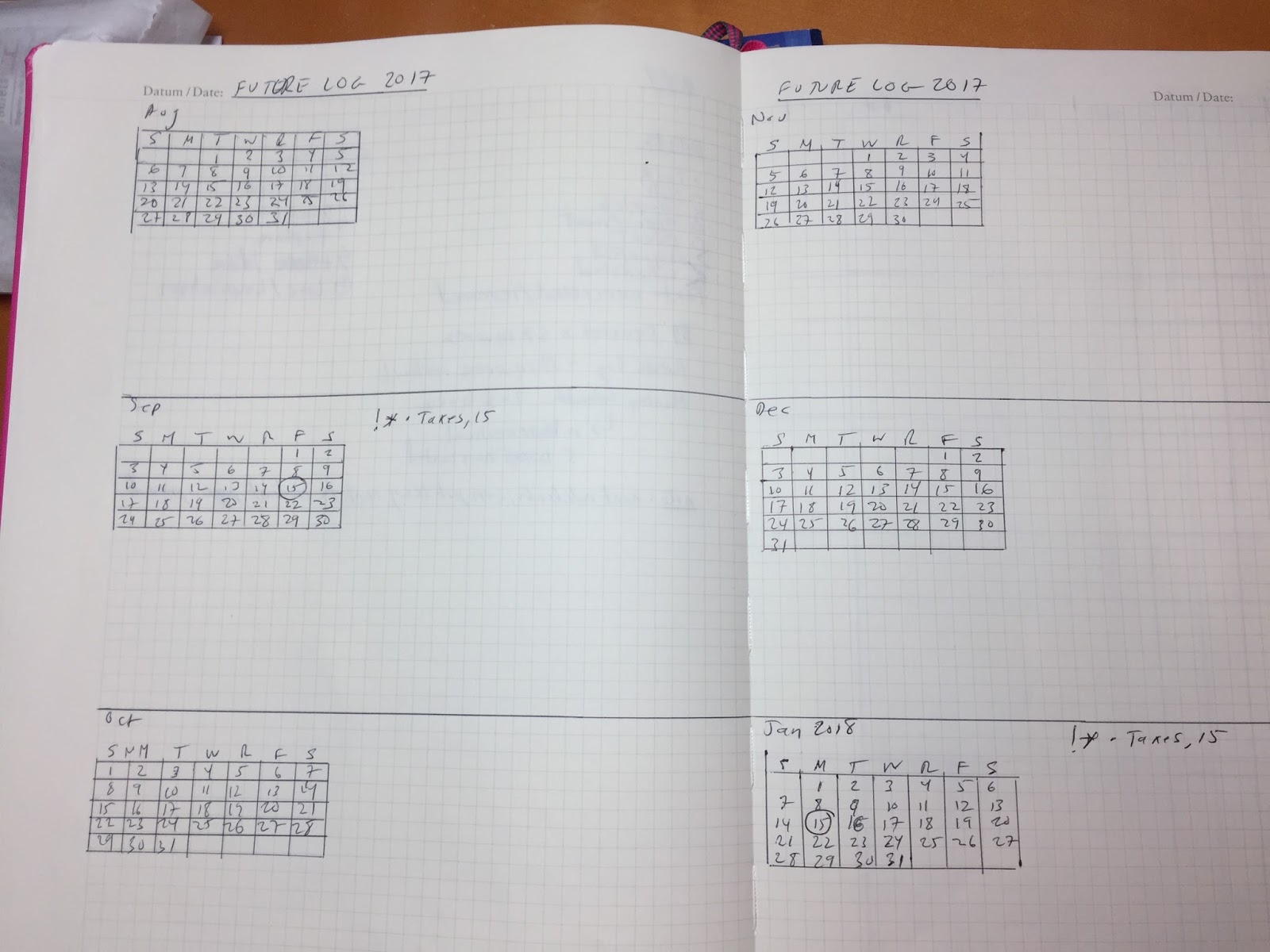
On the next Spread, I have the Future Log spread on pages 2 and 3.  You put 6 months per Spread.  The beauty of this system is that unlike planners, you can start at any month you want, instead of the usual January. Here, we started in August, so the Future Log spread runs from August 2017 through January 2018.

 
Future Log

Here's a close-up of the Future Log's September, which has the taxes due. 
For taxes due, that's on September 15th, I circle that day on the calendar. To the right, I put, in order: ! (signifying Deadline), * (signifying Important) and • (signifying Task).
 
Future Log, September, Close-Up
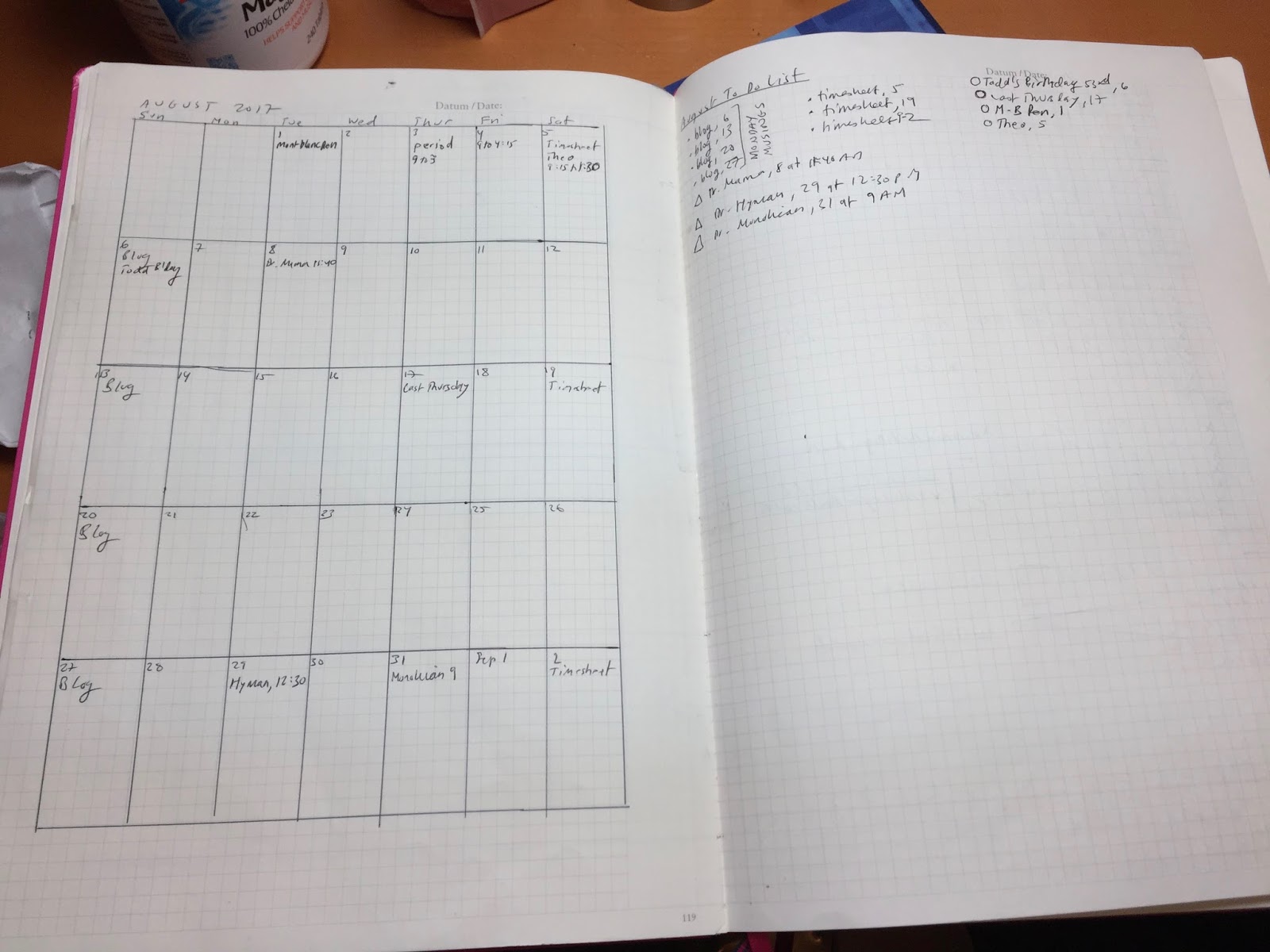
After the Future Log spread, here's the Monthly Log spread, Pages 4 and 5. On the left side of the spread is the calendar, and on the right is the Month's To-Do list, events, appointments.

Monthly Log for August
Close-up of the Monthly calendar, I have put in the events and appointments:
 
Monthly Log: August Calendar, Close-Up


This is the close-up of the other page of the Monthly Log, which is your to-do list, events and appointments. The • are the Tasks, ◯ are events like Birthdays, Holidays, and △ are scheduled events like Doctor's Appointments. As you can see here, blog is due on the 6th, 13th, 20th, and 27th. I'm quite surprised that I was organized enough to put all the dotted tasks first, followed by appointments below, and then on the right side, all the events. That's unusual for me, and most likely, in the future, this would not be organized.  However, by looking at the Monthly Log's calendar of this spread, you can see when all the events/tasks are scheduled/due, so organization of the To-Do List section of the spread is NOT necessary.
Monthly Log, August To Do List, Close-Up


After the Monthly Log spread, next spread is the Daily Log, pages 6 and 7. At the bottom is the Daily Habit Tracker. I only added 3 Habits, but will add more once I'm more consistent:

Daily Log Spread
This is a close-up of the Daily Log. The • is the Task, and the X means I completed the Task. The ◯ is an event and * is important:
 
Daily Log To-Do List, Close-Up


This is a close-up of the Daily Habit Tracker which I put at the bottom of the Daily Log. I made only three rows of the habits, and then the columns are the days of the week. I put X when completed the tasks:


Daily Log: Daily Habit Tracker, Close-Up

For the next spread after Daily Spread, you can include your Collections.  My Collections are: Gratitude Journal, Exercise Log, Video Games to Complete, Blog Ideas, and Dark Souls 3 Notes. You can make your Collections any subject you want, or not have any Collections.

My Gratitude Journal is very simple, on pages 8 and 9:
Collection, Gratitude Journal, Close-Up

Exercise Log follows on the next spread, pages, 10 and 11. I circle the days when I do at least 10 consecutive flights of stairs, so it can give me an easy visual as to how many days/week I've been exercising. As you can see, last week, I exercised twice, which are circled. Below the calendar, I just wrote dates, and #Flights. It may be hard to see, but the last entry is 8-2 = 10, 10 = 20 Flights:
Collection: Exercise Log, Close-up

Video Games to Complete, 11 and 12, this is a close-up to get a general idea. I put • next to each game, to cross out • once game is completed:
Collection: Video Games to Complete, Close-Up

Dark Souls 3 Notes is self-explanatory, but I made sure I start it on a new spread as per usual:
Collection: Dark Souls 3 Notes, Close-Up

The beauty of this system is that once you fill up the daily log, you can easily go to the very last blank spread, to make your next daily log. This is not an issue because you can index those pages so it will be easy to find. Further, the Leuchtturm has a bookmark that you can place for your current daily to-do list. If you run out of space for any of the Logs or Collections, then add that to your next blank spread, index those pages, and so on and so forth.

Now that you see how simple it is to make your Content, Key, and Future, Monthly, Daily Logs, and Collections, the organization plan is quite brilliant, which we'll break down.

However, first, watch the Youtube Video as it makes more sense to see the system in action.

For each day, write down • Tasks in the Daily Log. If you remember that you have something scheduled way in the future, like taxes due, put the Scheduled symbol (<) next to it. The < visually points back to the Future Log spread, and reminds you to add the task to the Future Log.
 
Daily Log, Migrated Tax with < sign

Then, go back to the Future Log, and put the Tax task in your calendar. As you can see, in this close up of the Future Log, I circled 15, and to the right, wrote down the Task (•) of paying taxes, with the deadline (!) and important (*) signifiers:
 
Migrated Tax Task to the Future Log
At the end of this month, August, look at all of your Daily Log lists. Scan for all the • that have NOT been crossed off, and see if you really need to do them. If not, put a line through the entire task.  But, if you still need to do them, put a Migrated symbol (>) on it, and write that task in the next month's Log, September, in the To-Do List section of the spread.  The > points forward, reminding you to put this in the next month's Log. 


Since we're not at the end of August, I don't have any examples of Migrated tasks, but will update this post with picture when the time arrives.

Next, look at the Future Log to see if you have any tasks for the upcoming Month, September, and then put that September task in your September monthly log spread. So, starting in September, I'll put taxes due in the September Monthly Log, and when it comes to the 15th, that would be on my Daily Log to do list.

And that's all there is to it!

I really love this system as you can see everything on paper, and can easily flip the pages back and forth, which is much faster than electronic systems.

Conclusion: Do not be intimidated by the fancy artwork, perfect handwriting and calligraphy, fancy fountain pens, and terminology of the Bullet Journal world. Your Bullet Journal can be as simple as the one I've shown. Those who are creative, by all means draw! This is your journal to do whatever you want with it!

The How of Happiness Review

Sunday, July 30, 2017

Fountain Pens

Fountain Pens 
As I got swept into the world of Bullet Journaling, the hot topic is fountain pens, and I remember growing up, I've always wanted a very nice fountain pen, given my love of stationary, so I wanted to learn more about them.

I read about the basics of fountain pens, and my heart sank. The very first and basic point made about fountain pens is that you should NEVER let anyone use your pen as it would change the way the nibs feel, as they're shaped by the individual way that you write and place pressure, so it would warp the nibs in the wrong way, that won't be uniquely yours, if someone dares even breathe on the pen!

That's a complete deal-breaker, because the most fun part of pens is sharing them with your friends, so you can have a rich discussion into the feel, the color, how fun it is and how it compares to other pens.

I remember when my friend and I were surprised that we both felt that this particular drug-rep pen is the best, because the ink has a clicky feel when using it that's extremely pleasant, and it makes you write neater, which is hard to explain, but we both agreed at once. And, it was fun to discuss why we love this pen so much. We both then bitched and moaned that we didn't have the foresight to grab all these pens, as they're not sold on the market, when these incredible pens ran out of ink. To this day, I can't find a comparable pen. 

The other issue of fountain pens is that it appears that Clairefontaine paper is the only paper that can truly take fountain pens with confidence, as other papers have issues of ghosting and bleeding, so you're stuck with only Clairefontaine and Rhodia (which has Clairefontaine paper but only at 80 gsm weight) notebooks, as the most accessible notebooks that you can buy online. 

There are other esoteric notebooks that have Clairefontaine paper, but hard to find. Further, both Clairefontaine and Rhodia don't quite have the style of Bullet Journal that I'm looking for, lacking many fun colors of other more "main stream" notebook lines.

The final problem is that fountain pens are outrageously expensive, some can cost a thousand dollars (?!??), so considering how easy it is to lose pens, I don't find this makes anyone comfortable to even use. I feel like I'd need it in a lock box at all times. For me, Fountain Pens are a bad idea!

Dark Souls 3 Progress
Being distracted by the world of Bullet Journaling, I've made minimal progress since last week. Since I'm really into journaling, I've been taking notes of all the items, so it certainly reminds me of my college days, and propelled me to write a review of the Getting Straight A's book. However, the note taking, though solidifying my memory, takes quite a long time.

Disgustingly Cute Pictures
I apologize for this short post, because I also have to recover from sugar overdose after seeing these pictures

The How of Happiness Review.

Saturday, July 29, 2017

Getting Straight A's

GETTING STRAIGHT A's by Gordon Green, Ph.D. 
As school is about to start, I thought I should post a review of the BEST college "textbook" I've purchased, which is Dr. Green's Getting Straight A's.

I never took high school seriously, most likely because it was free, and there's something to be said of having to pay for something that makes it appear more valuable.

At any rate, when I started college, there was significantly less structure and less input on what is expected, as college affords tons more freedom, whereas high school tends to be spoon-fed to you. Therefore, I had no idea what I was doing, and wasn't doing well in my classes, which made me feel guilty as money was being thrown away.

I'm not sure how I came upon the book: if I found out about it after doing research, or if my friend showed me this book when we were both struggling with our classes, and told me how effective it was.

At any rate, when we both read this book together, it was a complete revelation; light bulbs were turning on, and angels were singing. The reason why this book is so successful is for four reasons.

The first is that Dr. Green understands how professors think. The concept behind his system is that your professors are presenting their entire life's work and passion, and if you parrot back exactly what they say on your paper and exams, they will give you an A, if not an A+. I can NOT emphasize how true this is! Since you're validating and showing your appreciation of their life's work, of course they'll shower you with praise and best grades.

Further, it shows to them that you are paying attention to them AND are equally passionate (after all you're memorizing everything they're saying), which further strokes their ego, especially if you further ask them questions to clarify.

When the tables were turned and I was teaching a class, it was so much easier teaching the same material to one particular class where the students were very enthusiastic who asked questions and were attentive, but extremely difficult and uncomfortable with another class where the students were not paying attention and were disinterested.

I can't impress how much I appreciated the first class, and I actually complained about how awful this second class is to my friends, constantly. We all have biases, and if you're an enthusiastic and respectful student, and your grade hangs in the balance between B+ and an A, your professor may give you the benefit of the doubt and give you an A. I know I will because I would think that you've put in a lot of hard work into the class, and deserve the higher grade.

At any rate, one comment on one of my college exams, which made me giggle, is a theory I wrote, which was literally verbatim what this professor said so many times, and he wrote (underlining the theory in question), "This is so brilliantly put, I never thought about that!", which he obviously has. I was not surprised that I got an A+ on this particular exam.

The second reason why this book is so successful is that it doesn't take a lot of time to do the system. I did NOT follow exactly everything the author recommended, but I still got A's. I do remember spending 1 hour a day of work, maybe a little more over the weekends (i.e up to two hours a day on weekends).

I distinctly remember that it was in fact just 1 to 2 hours because my friend and I were incredulous that her sister's boyfriend was studying "only six hours that day" instead of his usual 10 to 12 hours/day. We felt there's no way we can possibly study for 6 hours, not to mention 10 to 12.

The way to go about memorizing verbatim:
  1. Do the reading beforehand, so you can follow what the professor is saying more easily. Attend EVERY single class and borrow notes if you're sick (or have a friend record the lecture as long as the professor allows for it) and take your own notes when you're feeling better.
  2. Sit in the very first row up front to prevent distractions, so you don't miss a thing. Take notes verbatim. Write down EVERY word that they're saying. I scored "Brownie points" when I missed something, and asked professors to repeat what they said. If you're still unclear, attend office hours to clarify things, which I abused.
  3. As soon as possible after class (preferably that very day, ideally in between classes if you have free time), write question on one side of index card, and then answer on the back side of the index card based on your notes.
    • Ex. your professor said, "The best game is Dark Souls 1".
    • Front side of index card: "What is the best game?"
    • Back side of index card: "Dark Souls 1".
As I'm beginning to actually hate Breath of the Wild (probably due to the undue, over-the-top praise that's making me gag), do NOT test the professor by being cute and writing down Breath of the Wild instead of Dark Souls 1. I believe students might think if they give out original, creative thought, the professors would "appreciate it", which they might, but they're not going to love your ideas as much as their own.

I'm not sure what the next details are, but if my memory serves me right, over the weekend, take all the index cards and memorize the answers. Do the reading for Monday. I believe you then take all the index cards, and memorize all of them a couple of weeks before the exam. Day before the exam, go over the cards again. Then spit out the exact wording on the exams and collect your A+.

The third reason why this book is so successful is that you don't have to be organized. I read other books of this kind to see if Green's book is truly the "best" on the subject. When I read what these other authors advise you to do, it was so complicated that I need an organizational flow chart just to follow their methods!

Envisioning myself doing this, I felt so overwhelmed and overwrought. They even discussed scheduling your hygiene while in college, which is ridiculous. If, by their methods, you don't have enough time that you have to schedule when to brush your teeth, you know they're doing something wrong.

The fourth and last reason as to why this book is the best investment you can make in college is that you DO end up learning interesting things with all this memorizing, yet you only spend at most 2 hours/day on studying, and you have the rest of the time to have fun (hopefully you don't have to work during college).

So it allows you to have balance in your life as opposed to following ridiculous, convoluted organizational systems of the other books. By having a balance, you'll enjoy your college life.

I didn't have any issues with writing papers, but I believe there is a sizable section in the book that describes how to write papers successfully and efficiently that's a good idea to go through, which I believe I did back then, but I forgot the details.

There's also a sizable section on how to read effectively as well, especially with liberal arts majors, the professors often give way too much reading. If you're taking math and engineering courses, in addition to the above, Dr. Green suggests doing as many problems as possible, perhaps even more than required, until you perfect your performance. I did very well in my Symbolic Logic class because I did every single question on the software, well beyond the homework requirements.

This book can be used successfully in high school and college, but I think with the amount of memorization that's involved in law and medical school, the book may not be as effective.

However, if you're a high school or college student, this book is a life saver! I know I tend to recommend borrowing books first and see if you find them helpful before buying, but in this situation, I would buy the book right now so you can read it before high school/college starts. Then, you can have the book with you during your school year to refresh and refer back to if you hit any stumbling blocks.

The How of Happiness Review

Wednesday, July 26, 2017

Bullet Journal: Brilliant Organization System

I was wondering why it was taking me so long to memorize the areas and all items of Dark Souls 3. And this is NOT necessarily what all the items are (except the important ones like weapons, armor sets), since it's hard to keep track between all the various titanite shards and soul items, but at least know that the items are there.

Also, I wanted to memorize these areas to the point where I can envision them in my head, so not needing visual cues of the game. I was rehearsing on the top of my head, and my friend actually thought I was talking to myself because I was lonely! But that's the level of memorization that I would like to have, to be able to visualize the entire game in my head.

This goal is made easier with:
  1. The save/copy method (I found out that gamers call this save scumming), and I have already made save files for all the areas in question
  2. DieNoob's Youtube video 
  3. Dark Souls 3 Cheat Sheet, as it's often faster to read than to watch.
I found out that it's taking me so long to accomplish for two reasons. The first is being distracted, especially as there are so many areas, and there were some save files that I haven't made yet, so I bounced between memorizing, and then progressing with the save files.

But, even after completing my save files, the second reason is that I was struggling to memorize some of the areas such as Smouldering Lake, which I feel is quite complicated as there are three levels (Lake, the ruins area, and the top area where the Ballista is), and it's very maze-like. Also, I have to follow a very specific route to avoid the poisonous ghrus, and to get all the items in a safe AND efficient manner (i.e. least amount of backtracking).

Because of the struggles with memorization, I decided to channel my inner nerd, and to take notes precisely because of the daunting Smouldering Lake. Further, it would be nice to record other areas as reference as it would solidify my memorization.

Since I didn't have a notebook, and wanted a rather nice one (this is Dark Souls 3, after all), fueled by my love of stationary supplies, I confess that I got a Moleskine A4-sized, lined notebook (A4 has almost the same dimensions of American letter-sized paper).

However, I can see myself taking more gaming notes, and although the Moleskine is rather lovely, I'd rather not buy Moleskine after Moleskine, and find something more affordable but just as nice. It seems we're paying a hefty price for the name brand, after all.

Upon googling, "alternative Moleskine notebooks", the research was fascinating. First, I found that these serious journal users all slammed the Moleskine as the paper is supposedly awful for fountain pens and gel ink. For my normal ball point pen, there were no problems with ink bleeding through the paper, but it's rough and not smooth like the notebooks with Clairefontaine paper that these journalists swooned over. But what's way more fascinating with the research was the world of Bullet Journaling.

I may have been living under a rock, but I haven't heard of Bullet Journaling since organization is not my strong suit. But, since Bullet Journaling kept getting referenced over and over and over again in my research for alternative notebooks, I wondered why this is all the rage? Especially, as I thought it was impractical, considering the samples I've seen--are all Bullet Journalists professional artists with perfect hand-writing and mastery of calligraphy?

It also seemed hoity-toity with journalists going into the pros and cons of esoteric paper products and fountain pens, made worse with them calling it BuJo for short. Nevertheless, I was intrigued by the contradiction: given my perception of how much effort and time BuJo takes, I wondered why this is all the rage, AND, the contradiction that these same journalists stating that it was easy, and all you need is a notebook and a pen. So I looked more into Bullet Journaling.

Bullet Journaling was created by Ryder Carroll, but I couldn't find when BuJo became disseminated. This introductory site showed how easy it is to start one, and I appreciate the simplicity. In the past, the rare situations when I made to-do lists, it takes much longer to type in a to-do list app, and so much easier and faster to hand-write.


Plus, it's annoying to click the box when the task is completed, as sometimes this doesn't get registered, whereas, when you complete an item in your Bullet Journal, you just cross over the dot, which takes less than 1 second.

Also, it's just easier to read and see everything on a piece of paper, and it's there for immediate viewing. Whereas, with electronic means, you have to click on app, and then click on the to-do list, and so forth.

In other words, I decided to use this system for Dark Souls 3 goals to keep me from getting distracted, and due to the BuJo format, it was easy to see what needs to be accomplished. It was also very satisfying to cross the dots, which is way more elegant than crossing them out, because you can see what you've accomplished.

BuJo Example: Dark Souls 3 to do list
Needless to say, my journaling is absolutely hideous compared to the BuJo gurus, but the beauty of it is that even with awful handwriting and crossing things out due to mistakes, it's actually very easy to read, and practical to use.

Further, you can make it as simple or as elaborate as you want. Aside from the few rules of dot, x, <, >,  circle, and -- (dash), you can design it any way you want.

Even with this extremely simple list I wrote, you can see how a to-do list app can't even do the "memorize" part of the list. Plus, what if you want to doodle under "memorize". I'm sure there's an electronic form of BuJo, but I can see it having the same exact pitfalls of a simpler to-do list app.

I see BuJo as extremely practical and helpful on a day-to-day basis, but it can also unleash your creative side if you want to make BuJo your hobby, as its nature invites unlimited expression.


Common types of lined paper
Because of the bullet-nature of BuJo, I would recommend getting a book that has grid (organizes your indents) or dot grid if you want a more unobtrusive style. For me, given my messy, disorganized handwriting, the grid-style system makes more sense as it will give me more structure.

For those who are more creative and want to draw, the dot grid style is a better choice. I would avoid the blank and lined style for BuJo purposes.

I admit that after reading about the Baron Fig, Clairefontaine, Leuchtturm, Rhodia, Semikolon, and other branded notebooks, I fell into the trap of materialism, as opposed to my original research intention of finding more cost-effective notebooks than the Moleskine.

I was seduced by the Leuchtturm New Pink Master Slim A4+ notebook and the Clairefontaine A4 notebook with french-ruled paper.  I haven't received the 2 notebooks yet, but I wished the Leuchtturm had French-ruled paper, as it seems like it would organize my handwriting even better than the grid style. I'll post comparing the Clairefontaine, Leuchtturm, and Moleskine notebooks once I test out the first two.

I now understand the popularity of BuJo, as not only is it fun, but it helps organize your day and makes you feel accomplished, which is refreshing. For now, with the Moleskine, I'm taking DS3 notes of the areas, and then intermixed with BuJo daily to-do tasks. I haven't looked any deeper into BuJo aesthetics, but I believe since you can do whatever you want, you CAN have a bulleted to-do list using the x, circle, --, >, < method, and the next page, a free-style note taking section. It's not like you MUST follow rules to the exact letter.
French-Ruled Paper

Conclusion: BuJo is both practical and fun, so it's the best of both worlds. This is easier said than done, but don't fall into the materialism trap like I did! I would start with an inexpensive Staples spiral bound notebook, or one of those old-school composition books with dot grid or grid style paper. If you're really into Bullet Journaling and/or want a more "permanent" notebook, I would definitely look into the brands I listed above.

The How of Happiness Review

Wooden Jigsaw Puzzles: A Comparison (Monday Musings 80)

ADDENDUM 5/15/21 After extensively puzzling with all three companies, Artifact, Liberty and Wentworth, I found Artifact to be, hands-down, t...